TURGORby Augmented Engineer

Sink your study.
Hit refusal by exam day.

TURGOR (TUR-gor)the inner pressure that stiffens a living thing and drives its roots down through hard soil into rock. This page is a boring log: everything above the line is loose material — scattered PDFs, unranked problems, hours that don't compound. Scroll down and watch it densify: timed problems, Apple Pencil workspaces, and a scheduling engine that knows the clock is part of the exam.

“…like a tree planted by water, that sends out its roots by the stream, and does not fear when heat comes.” — JEREMIAH 17:8

  Ground surface · begin boringGS · EL 0.0 FT
Stratum 1 · 0–6 ft — Fill & Topsoil SPT N = 4 · loose

Dark brown SILT with debris, loose, dry — undocumented fill. Zero bearing capacity. This is where everyone starts.

Flashcard apps break at minute fifteen.

Studying for a professional exam is loose material — scattered PDF manuals, unorganized lectures, stacks of paper, and no idea what you're actually rusty on. Standard study apps are built for one-word answers; they collapse when the rep is a 15-minute structural calculation that needs a scratchpad, a code sheet, and sustained focus. TURGOR is a spaced-repetition engine built for exactly that kind of problem — and you can't build on fill. Your roots drive through it.

Stratum 2 · 6–18 ft — Silty Clay SPT N = 9 · medium stiff

Gray-brown silty CLAY, moist — takes the imprint of everything pressed into it. This is the working layer.

The workspace

Solve like it's exam day.

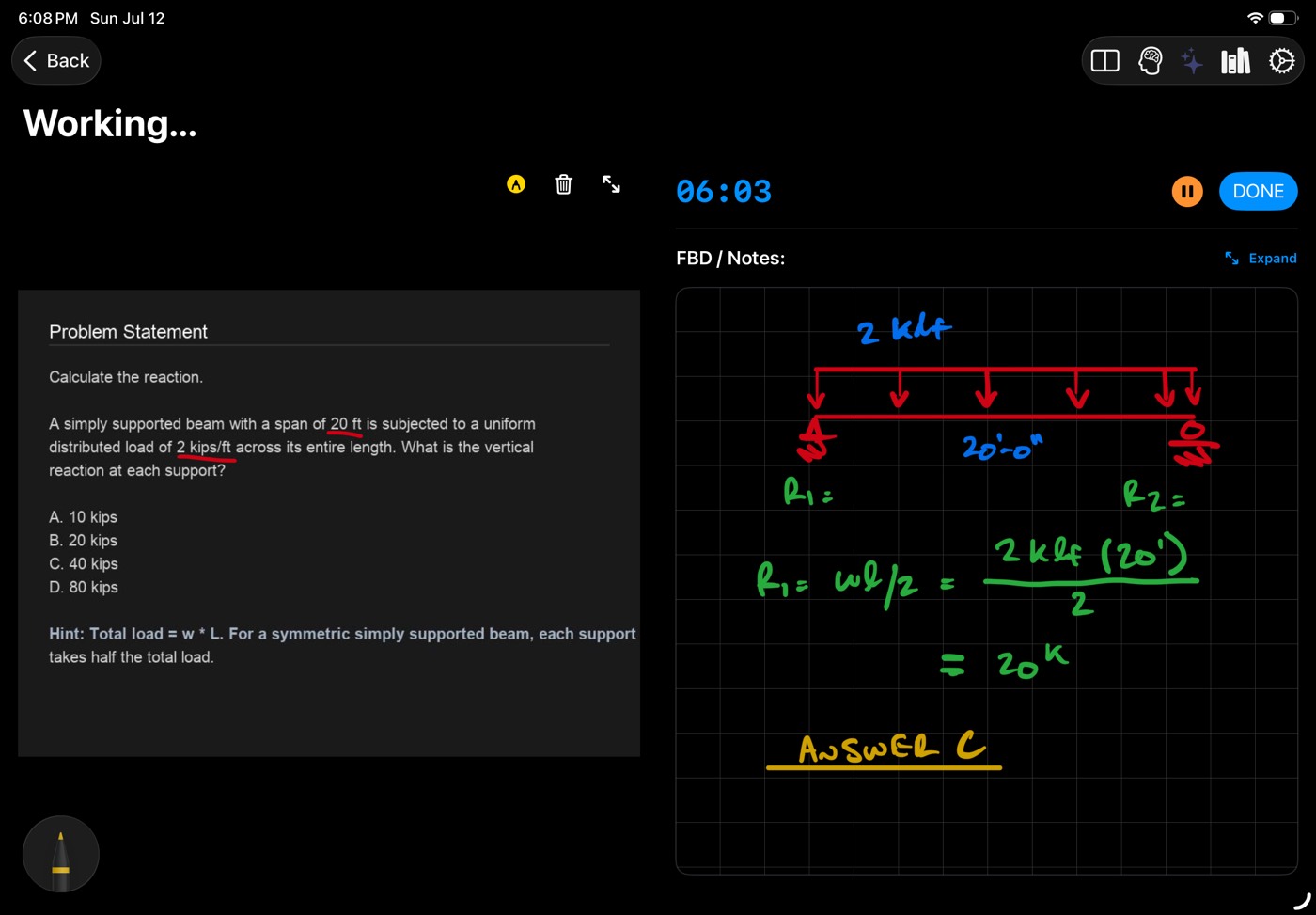
TURGOR on iPad: a timed beam problem beside a hand-drawn free-body diagram with colored ink

Timer, statement, infinite canvas

Every problem runs on a timer with your target duration. The statement sits beside an infinite Apple Pencil canvas — draw the FBD, run the numbers, underline the trap. Your ink is saved with every attempt, pressed into the record like a sample in clay.
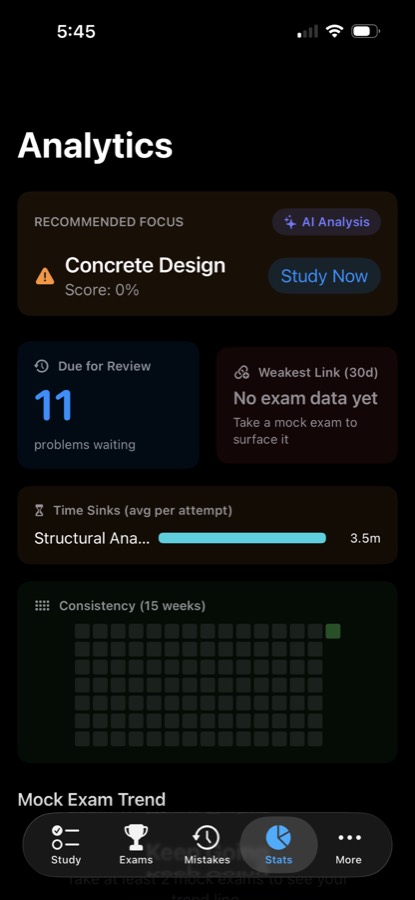
TURGOR on iPhone: analytics view in dark mode

Reference shelf, AI professor, pocket reviews

Pin your code sheets beside the problem and mark them up in permanent ink. Tag the exact minute of the lecture that teaches a problem and jump back to it in one tap. Ask the AI Research Professor when you're stuck. Review the queue from your phone in line for coffee. Everything stays on your device — local-first by design.

CAPTUREProfessor says "remember this"? Tag a flashcard mid-problem or mid-lecture — dictate it, front and back — and export the queue as CSV straight into Brainscape, Anki, or Quizlet.
TAKE IT ANYWHEREAny attempt — statement markup, FBD, solution — or your lecture notes exports as a clean PDF. Save it, email it, AirPrint it. Your work is yours.
SAFETY NETAutomatic rolling backups written into your iCloud or Dropbox folder — atomic writes, newest seven kept. Survives even deleting the app.
Stratum 3 · 18–30 ft — Fine Sand SPT N = 19 · medium dense

Brown fine SAND, moist — densifying as the taproot pressurizes it. Compaction is the whole point of this layer.

The Tier Model

The goal: get everything green.

Every problem in your rotation wears a flag from its last rating. Red means you can't do it yet. Orange means you can, but it's a fight. Blue means you know it — now it needs solid reps. Green means it's retired: mastered, fast, and down to a cheap concept ping on an automatic reminder.

AGAIN HARD GOOD EASY

Problems are classed at entry — automatically, from their full-solve time:

IN-DEPTH · ~45+ MIN

The monsters

Long multi-step problems — a chain of exam problems in a trench coat. These tier down as you master them, because nobody has time to re-solve forty 60-minute problems.

DRILL · ~15–45 MIN

The fundamentals

One core concept, one sitting. Always a straight solve — the bread and butter of a study day.

RIVET · UNDER ~15 MIN

Small but decisive

The five-minute problems that are easy to overlook and decide your score. Like a rivet: cheap, tiny, holds the whole structure together. Must be automatic.

For In-Depth problems, the rating is the prescription — how the rep felt decides what the next session even is:

RatingYou're sayingNext session
AGAINWrong or blankFull Solve — with your mistake log offered before you start
HARDRight — but a fightFull Solve — prove it whole, again
GOODRight — own the conceptsSetup Only — FBD + governing equations at ⅓ the time, no arithmetic grind
EASYOwned itConcept Review — a quick ping at ⅒ the time
That's how a 60-minute problem stops costing you 60 minutes — it becomes a 20-minute setup, then a 6-minute concept check, freeing your hours for what's still weak. Miss one three times running and the app says it out loud: stop drilling — go learn it — and if you tagged the lecture moment that teaches it, that advice is a button.

And ratings aren't guesses. After every big problem, a 10-second debrief — did you get it (right / close — slip / wrong)? how sure were you before checking? did the concepts fight back? — and the app suggests the honest rating. You always have the final word: a calculator slip can still rate Good, but it stays a slip in your stats forever.

Stratum 4 · 30–42 ft — Coarse Sand SPT N = 34 · dense

Brown coarse SAND, trace gravel, dense — the blow counts don't lie down here. Neither does the math.

The scheduling engine

SM-2, with a clock.

TURGOR schedules reviews with the SuperMemo-2 algorithm — the gold standard for spaced repetition — extended with a Time-Box Multiplier. Memory and fluency are two different axes: whether you remembered it sets the schedule, and how fast you were tunes how far the interval stretches. Beat your target and the interval grows more; run long and it grows less. Solve it suspiciously fast and the speed bonus is withheld — recognizing an answer isn't practicing it. And for long problems, the rating IS the prescription: Good means next session is Setup Only, Easy retires it to a quick Concept Review — the task shrinks as you master it, so a 60-minute problem stops costing you 60 minutes.

Interactive — run the actual math SM-2 + Rt

Wrong — even close? That’s Again. Hard/Good/Easy all mean correct — they only tune how far the schedule stretches.

  • Session target current method's time-box
  • Time ratio Rt = target / actual, clamped 0.5–1.2
  • Adjusted quality qadj = q × Rt — tunes ease only
  • Verdict only "Again" resets the schedulePASS
  • New ease factor
  • Review method scales off YOUR full-solve time
  • Next session the rating IS the prescription
  • Next interval ±8% fuzz smooths daily load
Next review

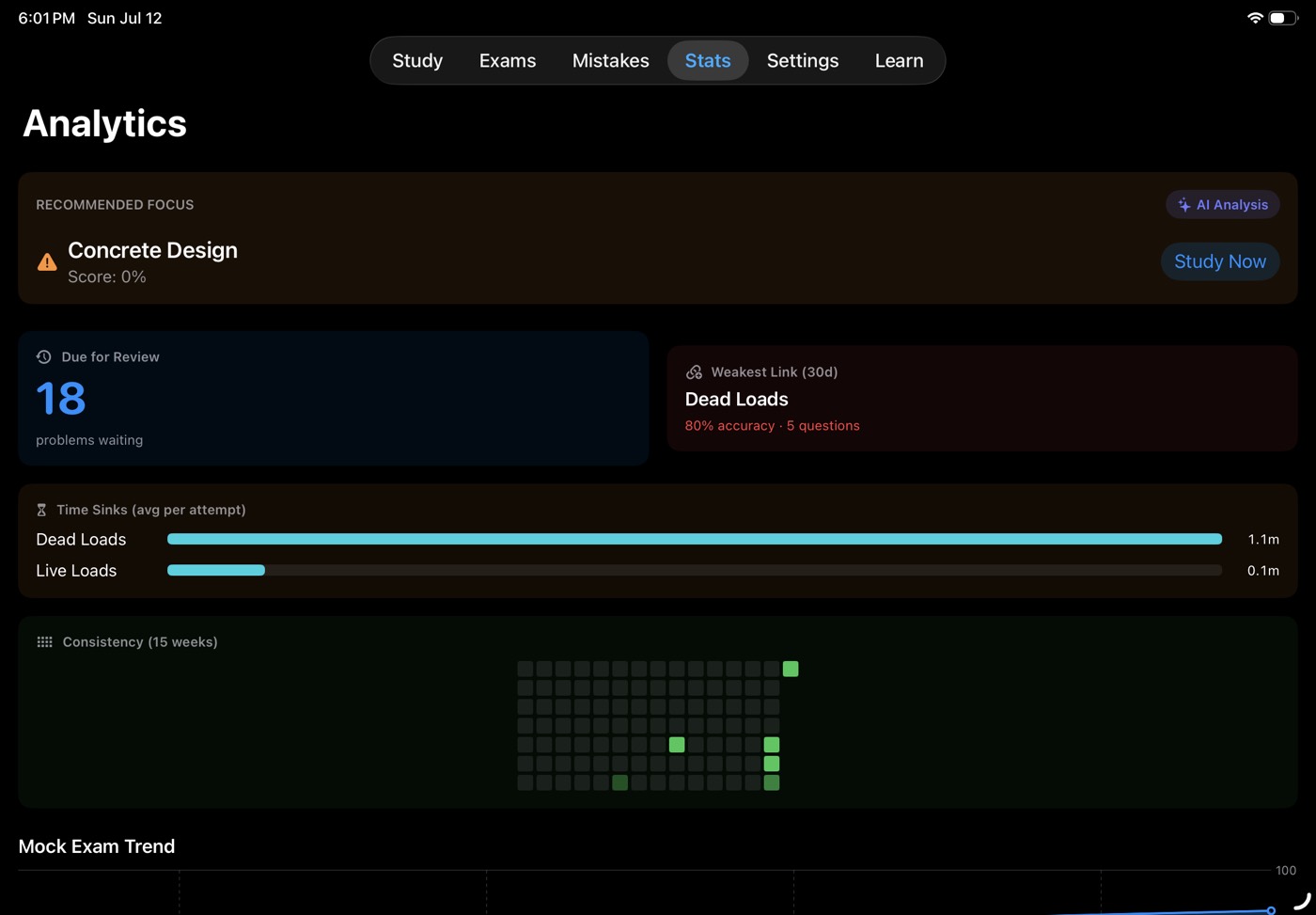
Analytics dashboard: due-for-review count, weakest link, time sinks, consistency heatmap

Analytics are your blow counts

You don't guess at density — you measure it. True Accuracy that can't be gamed (right · slip · wrong — a calculator slip rated Good stays a slip), Silent Killers (problems you were certain about and got wrong — the most dangerous cell on any exam), an Exam Forecast that says ON PACE or BEHIND with the problems-per-day to fix it, study allocation vs the exam blueprint, miss-reason patterns ("45% of your misses are unit errors"), time sinks, and your consistency heatmap — the dashboard tells you what to study next, not just what you did.

Solving 37% Learning 63%

The Study Mix splits active problem-solving from passive concept-learning — a built-in timer logs your lecture and reading time, so you can see when you're reading too much and solving too little.

Stratum 5 · 42–50 ft — Sandy Gravel SPT N = 47 · very dense

Gray sandy GRAVEL with cobbles, very dense — load-rated material. Rated for a date, not for forever.

Exam-aware scheduling

Built for a deadline, not forever.

Every other spaced-repetition app schedules for infinite retention — it will happily push a problem 200 days out. But your exam is on a date. TURGOR wraps the retention engine in a four-stage pipeline that turns "everything that's technically due" into "the most valuable thing you can do in the time you actually have today."

01 · CLAMP

Exam horizon

Intervals are compressed so nothing is ever scheduled past test day. The closer the exam, the harder reviews pull in — so a problem can't quietly vanish until after you've already sat the exam.

02 · WEIGHT

Blueprint weighting

Each topic carries its share of the exam. A 20%-of-the-exam topic outranks a 5% one when time is tight — your own weights, editable and shareable, for the PE or any exam.

03 · FIT

Capacity + priority

Your day is capped at a real budget (90 min by default). When due work overflows, a knapsack keeps the highest-value problems and rolls the rest to tomorrow — nothing lost.

04 · CRAM

Final 21 days

Standard intervals switch off. The engine recycles the highest-ROI problems you haven't mastered — reviews and never-solved alike — refilled to your capacity every single day until the exam.

Read-time, every day: clampweightfitinterleave. Change your exam date or a weight and today's plan reshapes instantly. And the day is mixed like the real thing: at most one In-Depth full solve, backfilled with Drills and Rivets.

An overloaded day — the knapsack decides 145 min due · 90 cap
ProblemTopic (weight)MasteryTimeVerdict
EConstruction (5%)weak10 min✓ Today
AStructural (20%)weak45 min✓ Today
CGeotechnical (15%)shaky30 min✓ Today
DWater Resources (12%)shaky45 min→ Tomorrow
BStructural (20%)near-mastered15 min→ Tomorrow
Notice what the math does: B is deferred despite being a 20%-weight topic — you've nearly mastered it, so it's low-value practice. And E makes the cut despite being only 5% — it's weak and cheap, so it's the best minutes you can spend. That's value-per-minute, not raw importance.
The dress rehearsal

A full exam simulator. Your problems, the real clock.

Studying tells you what you know. Only a simulation tells you how you perform when the clock owns you. TURGOR builds full mock exams from your own problem bank — and because you can flag problems as exam-only, the questions you sit can be ones your daily review has never leaked to you.

BUILD ITAssemble a mock from your bank — including problems reserved for exam day only, kept out of the daily rotation so they hit you cold, the way the real thing does.
SIT ITThe full workspace under the full clock: statement markup, FBD canvas, pinned code sheets. Per-question timing recorded — no hints, no pause-and-peek.
MINE ITGrade against your solutions, question by question. Every sitting feeds the analytics: the mock-exam trend line, over-budget questions, your weakest link, and the exam forecast.

The simulator is where the whole engine proves itself: the forecast says ON PACE — the mock is where you check its math against reality.

Stratum 6 · 50 ft — Bedrock SPT N = 50/2″ · REFUSAL

Gray BASALT, fresh, very hard — sampler bounced. Boring terminated. This is what competence feels like.

Refusal — bearing verified

Refusal. That's the plan.

“He dug down deep, and laid the foundation on the rock.” — LUKE 6:48

In the field, refusal means the material is so competent the sampler can't advance — the root has reached rock, and it grips. That's the whole app in one word: every flag green, every monster problem retired to a six-minute concept ping, your weak spots named and drilled until the exam can't make you flinch. Anchor in the rock, then go pass the thing.

The deal $39.99 once

Not a gym membership. Subscription study apps earn the most when you forget them — billing monthly whether you showed up or not, profiting when you study slowly. TURGOR earns the same $39.99 whether you pass in March or September. Our incentives point one direction: get you to refusal.

Nothing here rents. Local-first, your own AI key, no servers between you and your work — so there's nothing to charge rent for. Download it free and try it. If it earns a place in your prep, one purchase makes it yours forever: the PE now, the SE later, whatever your kids bring home.

This is the lowest price TURGOR will ever be. As it grows, the price grows with it — buying today locks yours in for good.

“…a merchant seeking fine pearls, who on finding one of great value, sold all he had and bought it.” — MATTHEW 13:45–46

Field manual — in production
T-01Build your problem vault: photos, time-boxes, and the batch JSON importer.
T-02Code-sheet workflow: pinning references and permanent Pencil markup.
T-03Mock exams and reading your analytics like a coach.